
What we look for in our stock
People often ask what “we” look for in a Gypsy or Drum Horse. What we look for in these breeds does not differ in what we look for in any breed. Good conformation is good conformation. Of course it all depends on why we are looking at the horse. Breeding, Dressage, Hunter Jumper, Western, Driving, etc…
The first thing that we take into consideration is the horse’s temperament. We want a horse that is social with humans and other horses . We like horses that enjoy being around humans, not just tolerant of them. The horse needs to be willing to learn and work.
The second thing that we look for is conformation. The horse should match the Breed Standard (In our case provided by the The Gypsy Vanner Horse Society or The American Drum Horse Association) as closely as possible. But beyond the standard, because we like our horses to be able to perform, we want horses built for a purpose.
The withers should be behind the elbow to allow the horse to open up it’s shoulders.
We like a horse that has an even top line. Of course this varies with age, but a mature horse should not be higher or lower in the front or back. Either fault will compromise the horse’s movement.
Pet peeve in these breeds….The horse’s front legs should be as close to the vertical as possible. The front legs, from the side, when standing square, should fall under, not behind or in front of the shoulder. The hock of the rear legs should fall as close to the vertical as possible to the point of the horse’s buttocks. If there are any major faults with the vertical fall of the horse’s front or rear legs, it will affect the balance of the horse. A balanced horse performs better and with less effort!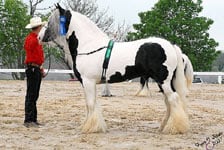

We like a horse that has a clean throatlatch..not thick which makes it hard for the horse to break at the poll. If the horse is too thick, and you achieve flexion at the poll, it’s going to cut the horse’s air supply off, causing the horse to have an inconsistent headset and make it hard for the horse to breathe, period. If the horse is to be driven, we would compromise, as the typical driving horse holds it’s head in front of the vertical, not on it.
We like a horse whose leg bone is proportional. The short bone (cannon bone) should be half the length of the Long bone (forearm). They should NEVER be the same length nor should they be opposite in proportion..
Another thing that we look at is movement. When a horse is walking the horse should have four even beats, that cover ground with a step from behind that comes fairly close to where the front foot takes off. At the trot, the horse should naturally reach from behind and again, we like to see the horse’s rear hooves touch down where the front hooves took off. The trot should be a clear two beat gait. (We know that DAP (Diagonal Advanced Placement***) is acceptable and desired in some draft breeds, but we maintain that a trot is a solid two beat gait, anything else “we” consider a fault) The Canter is a gait in which we expect three beats and the horse should drive with his hind end, without being heavy on his forehand. Four beats is totally unacceptable, but this is usually human error, and not natural. The horses front and back hooves should never hit or touch when the horse moves at any gait.
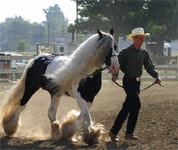
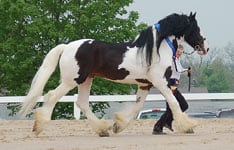
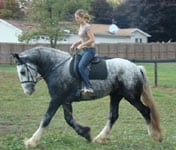

While it helps to have natural movement for genetics and breeding, there are some situations where training can help or hinder a horse’s movement. It is important to take that into consideration when choosing breeding stock.
As with any breed, any horse, we of course have to mention that hock placement, shoulder slope, and bone play a big part in our decision. Hocks should set fairly close, but not sickle hocked and certainly should never touch when standing or moving. We like a thick boned horse, but still light enough that they can move with little effort.
Last on our list is the aesthetic look of the horse. A perfect Tobiano pattern or a pretty head is wonderful, lots of feather is nice to look at, but they do not make a horse’s ability to perform better…and the whole reason for a breed standard is to define a horse’s purpose for being bred…it’s use to the people who own or want to own it. (In other words, you can not ride a horse’s head and a certain color will not make a horse more likely to perform better!) Without a niche, a breed will not survive and will not maintain worth. We understand that the cosmetic look of a horse is important, but we only take it into consideration after all other points above have been met and we are most willing to compromise in this area.
**It is important to note that in Breeding Stock, we go a bit further. The horse’s bite is looked at. We look at a mare’s reproductive build…her Caslick’s Index, etc… as well as the stallion’s reproductive organs. The overall condition and health of the hoof, the actual horse, ect… They are also subject to various pre-purchase tests that a typical riding or using horse would not go through.
***DAP. Diagonal Advanced Placement is thought to have come about because certain heavier breeds needed to reduce stress on their legs and hooves. This is a trait that has naturally evolved, not human intervention.


